
Need this sorted?
Need help with soft washing? Book soft washing or get a quote from OOR External.
Where the term comes from
The name simply contrasts with pressure washing. A pressure washer removes grime by force, which suits hard concrete but can scar softer materials. Soft washing turns that around: pressure is kept similar to a garden hose, and chemistry rather than force loosens the growth. The phrase became common as more homeowners looked for safer ways to clean render and roofs.
It is sometimes called low-pressure washing or chemical washing, and those names describe the same basic idea.
What a soft washing solution contains
In general terms, the solutions are biocides and surfactants diluted in water. The biocide kills the living organisms, such as green algae, black mould and lichen, that cause most staining on walls and roofs. The surfactant helps the mix spread and cling to the surface so it has time to act. Strength is adjusted to the surface and the level of growth rather than one mix being used everywhere.
Professional operators follow product labels and safety data, and protect plants, pets and nearby people while the solution is in use. Rinsing afterwards matters just as much, because leftover solution should not be allowed to dry on glass or frames.
How the process works step by step
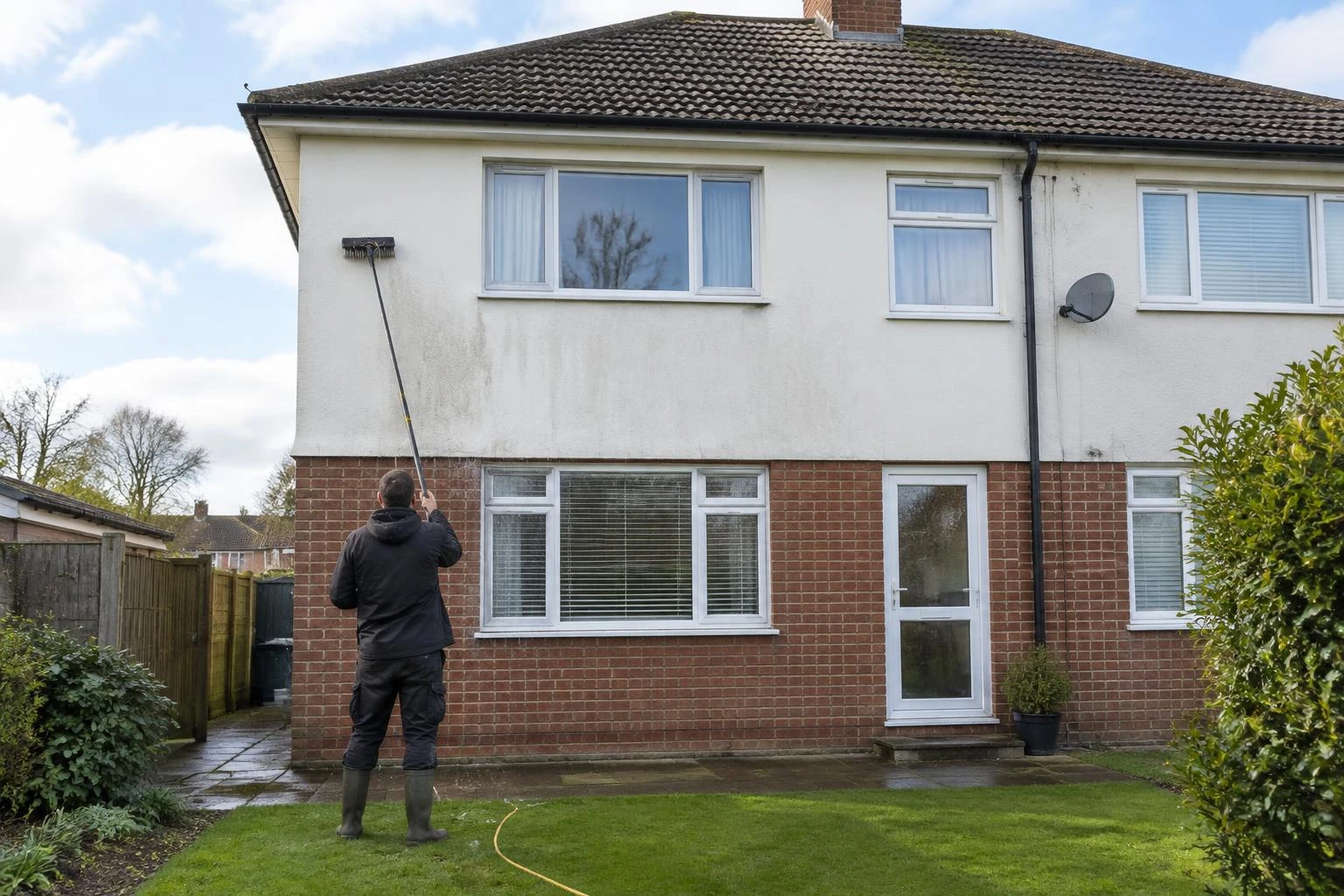
The surface is checked first, along with windows, vents, plants and anything else nearby. The solution is applied at low pressure, usually working from the bottom up so streaks do not form. It is then left to dwell, which can mean several minutes, while the growth breaks down. Finally the area is rinsed at low pressure, and nearby surfaces are rinsed again to remove any runoff.
Some staining keeps fading over the following days and weeks, because dead growth continues to weather away after the visit.
Surfaces soft washing is designed for
The method suits materials that are porous, coated or easily marked. Typical examples are painted and through-coloured render, K Rend and similar monocouche finishes, pebbledash, roof tiles and slate, timber and fibre cement cladding, uPVC fascias and soffits, and brick where the mortar is soft. It is also widely used on commercial cladding and signage where a factory coating must not be damaged.
Very hard, non-porous surfaces such as concrete drives can still be pressure washed, though soft washing may be used alongside to treat growth.
What soft washing does not do
It does not repair cracked render, replace lost mortar or restore paint that has failed. It will not remove every stain either: rust, paint splashes and some mineral deposits need other treatments. Understanding this up front helps set realistic expectations.
If you are weighing up the two main methods side by side, the pressure washing versus soft washing guide covers that comparison, and the guide on whether soft washing is safe deals with plants, pets and surfaces. Neither topic is repeated here.
Is it a DIY job?
Garden centre algae products work on the same principle and can help on small, low areas. Larger walls and anything above ground floor height bring ladder risks, overspray onto windows and plants, and the chance of patchy results. Professional equipment, controlled mixing and proper rinsing are what make a soft wash even across a whole elevation.