
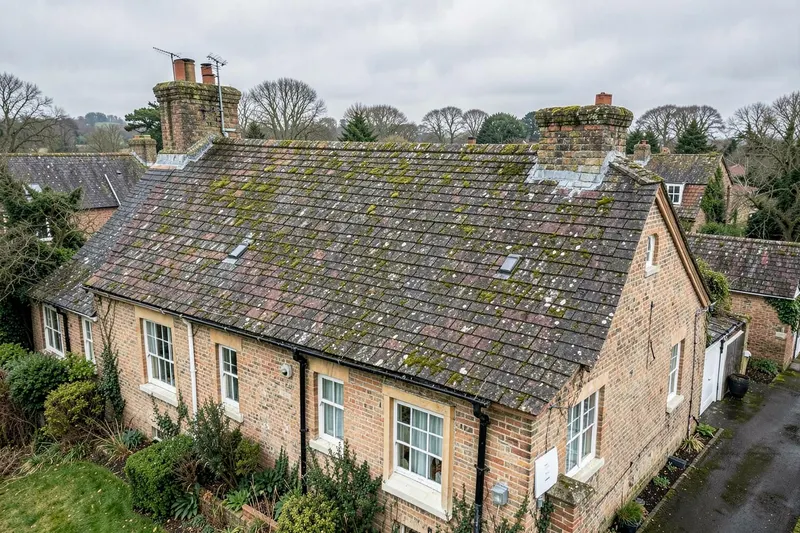
Lichen versus moss
Moss is a plant. It grows in soft green cushions, holds water like a sponge and comes away in clumps. Lichen is a partnership between a fungus and an alga, and it behaves very differently. It forms thin, tough rosettes pressed flat against the surface, grows slowly and fastens itself into the texture of the tile. Many Kent roofs carry both, with moss in the shaded joints and lichen spread across the open face of the tiles.
That difference matters because a method that lifts moss easily can leave lichen almost untouched. Treating them as the same problem is the most common reason a roof looks patchy a few months after it has been cleaned.
Why lichen grows on Kent roofs
Lichen likes clean air, moisture and a surface that stays put. Coastal towns get damp, salty air off the sea, and rural parts of the county have the clean air lichen thrives in. Roofs shaded by trees or neighbouring buildings stay damp for longer, which gives growth more time each day. Older concrete and clay tiles with a rough, porous face give it the best grip of all.
Does lichen damage tiles?
Lichen is slower and less dramatic than moss. It does not build thick cushions that block gutters. However, it does hold moisture against the tile surface, and over years its anchoring growth can roughen the face and help other growth settle. On most roofs the main concern is appearance and the way lichen gives moss somewhere to start, rather than sudden damage.
Why scraping alone doesn't work
Scraping removes the visible crust but rarely gets the anchoring growth out of the tile pores, and heavy scraping can scratch the surface or loosen tiles on an older roof. Strong pressure washing carries a similar risk to the tile face and to the pointing. The result is often a roof that looks clean for a short time and then shows the same patches in the same places.
Removal followed by biocide treatment
OOR External starts every roof by checking the covering, pitch, condition and safe access before agreeing a method. Loose growth and debris are removed with a technique chosen for the tile, and a biocide treatment is applied afterwards to kill what remains in the surface. On roofs where heavy removal is not advisable, a treatment on its own can be the gentler option, allowing the growth to die back gradually.
The treatment needs time on the surface to work, so it is best applied in a dry spell. Loosened material is cleared from the gutters and downpipes rather than left to cause a blockage.
What to expect afterwards
Treated lichen does not vanish overnight. Once it has been killed it loosens its grip and fades, and rain and weather wash the remains away over the following weeks and months. That gradual change is normal and is a sign the treatment is working, not that it has failed. Expect the colour of the tiles to even out over time rather than all at once.
Preventing regrowth
No treatment makes a roof permanently clear, because new spores keep arriving on the wind. You can slow the return by trimming overhanging branches so more light and air reach the tiles, keeping gutters clear so water drains away, and dealing with small patches before they spread. A biocide applied after cleaning gives the roof a clean starting point. For a sense of what roof work typically involves in cost terms, see the roof moss removal cost guide.