
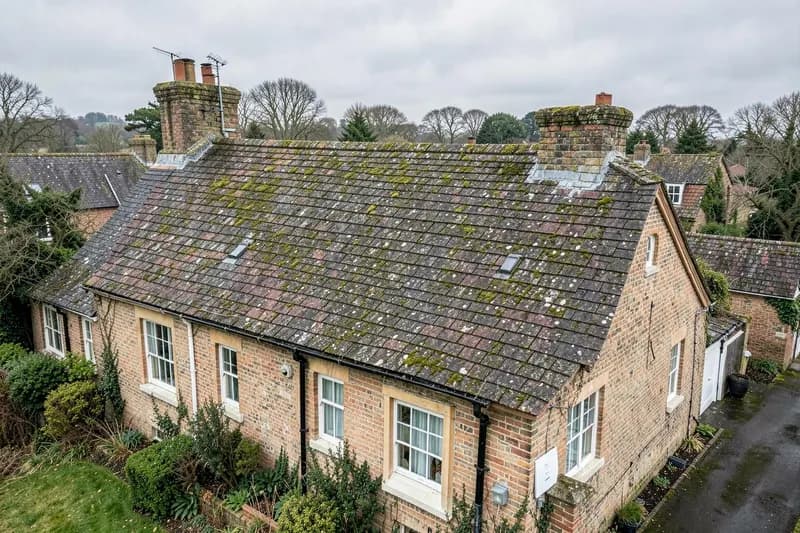
Covering, condition and access before cleaning
Roof Cleaning in Sittingbourne
Roof cleaning in Sittingbourne brings different questions on older terraces, newer estates and working premises. OOR External assesses the roof before agreeing a method. Commercial work is quoted further across Kent; homeowners should check their postcode first because domestic coverage is normally within about fifteen miles of Dover.
Request a free quoteMilton Regis: older roofs and shared boundaries
Sittingbourne made its name making bricks and paper from its clay substrata, and Milton Regis High Street is one of the town's conservation areas, with around 128 listed buildings within a couple of kilometres of the centre. Older terraces around Milton Regis can have limited side access and roof slopes that continue across property boundaries. A chimney, rear addition or small courtyard can change both the cleaning scope and the safe route for equipment. The roof seen from the pavement may not show those details.
Include a view of the rear where it is safely accessible and explain whether an adjoining property affects access. Cleaning should not push loosened material into somebody else's gutter. A managed block or row of premises needs a clearly identified scope rather than assumptions about which roof sections are included.
Murston: roofs beside working premises
Around Murston, residential streets and industrial premises present different access conditions. On a commercial enquiry, the available space may be used for deliveries, parked vehicles or staff routes. Cleaning needs to fit those movements rather than occupy a convenient patch of ground without agreement.
Send information about opening hours and the person coordinating the visit. The covering may be coated metal rather than tile, and fragile sheets or rooflights need their own assessment. The shape of the roof and the use of the building are both relevant before a method is proposed.
Kemsley and concrete interlocking tiles
Kemsley was built as a model village for paper-mill workers in 1924, and the newer estates around it include profiled concrete tiles whose edges and rough faces can collect moss. A shaded slope can show growth before a sunny one, even on homes of similar appearance. That difference does not prove a roof is defective or that its tiles require replacement.
For concrete tiles, describe moss at joints, fallen clumps and any particles accumulating in gutters. Surface wear should not be mistaken for a stain that needs scrubbing away. The dedicated material page explains why the tile face and interlocks deserve care during assessment.
Bapchild and the edges of the town
Towards Bapchild, garden planting and more open surroundings can produce a different pattern of shade and debris. A roof beside mature trees may gather leaves as well as moss, while an exposed slope dries differently. Those observations help identify what is actually reaching the outlets.
A single dark photograph can hide that pattern. Show the complete slope and the ground below, including extensions or conservatories that interrupt access. Do not climb to pull growth away or test whether a tile is loose; known roofing concerns should be described for separate advice.
New-build estates versus older terraces
Age alone is not a cleaning method. A newer tiled roof may have accumulated growth in one sheltered corner, while an older terrace may carry only light marks on a serviceable covering. The sensible scope follows the problem rather than a general rule about how old a roof looks.
A broken tile, loose ridge or active leak is a matter for a roofer. OOR External does not carry out roofing repairs. Cleaning can be considered when the covering is suitable, without presenting an appearance change as a repair or a promise about remaining life.
Careful removal with drainage considered
On appropriate tiled roofs, loose growth is removed with care and biocide is offered as a separate line. Slate is handled by soft wash only. The quotation explains the method for the covering rather than applying one process across every roof material.
Gutters and outlets are cleared after roof cleaning because they receive loosened debris. Mention lower gutters on extensions and any previous overflow. That helps plan the route of material and runoff instead of treating the main slope as an isolated surface.
Agreeing access before a journey or booking
For commercial work in Sittingbourne, timing can be planned around the occupied site, deliveries and safe exclusion zones. Specialist access is discussed and priced before work starts. An apparently open yard is useful information, but does not establish whether the roof itself can be walked on.
For a domestic enquiry, check your postcode before gathering detailed photographs or expecting a date. Once coverage is confirmed, send views taken safely from the ground and explain the growth or drainage concern. Jordan can discuss a free written quote with the included slopes and treatment clearly identified.
Related local pages
- Roof Cleaning in Dover
- Roof Cleaning in Canterbury
- Commercial Roof Cleaning in Medway
- Roof Cleaning in Thanet
- Gutter Cleaning in Sittingbourne
- Pressure Washing in Sittingbourne
- Roof Cleaning and Moss Removal in Ashford
- Roof Moss and Lichen Removal in Maidstone
- Roof Cleaning in Folkestone
- Roof Cleaning in Kent
Roof cleaning in Sittingbourne: questions
- Are Sittingbourne homes within the normal domestic roof-cleaning area?
- Do not assume coverage. Please check your postcode first: the normal domestic area is about fifteen miles from Dover. Commercial work is quoted more widely.
- What should I show for an interlocking-tile roof enquiry?
- Show the full slope, moss around joints and the eaves, plus access below. Mention visible wear or known defects without climbing to investigate.
- Can a Milton Regis terrace be assessed with front photographs alone?
- A front view may hide rear additions or restricted access. Include safe rear views if available and describe shared boundaries so the cleaning scope can be discussed accurately.