
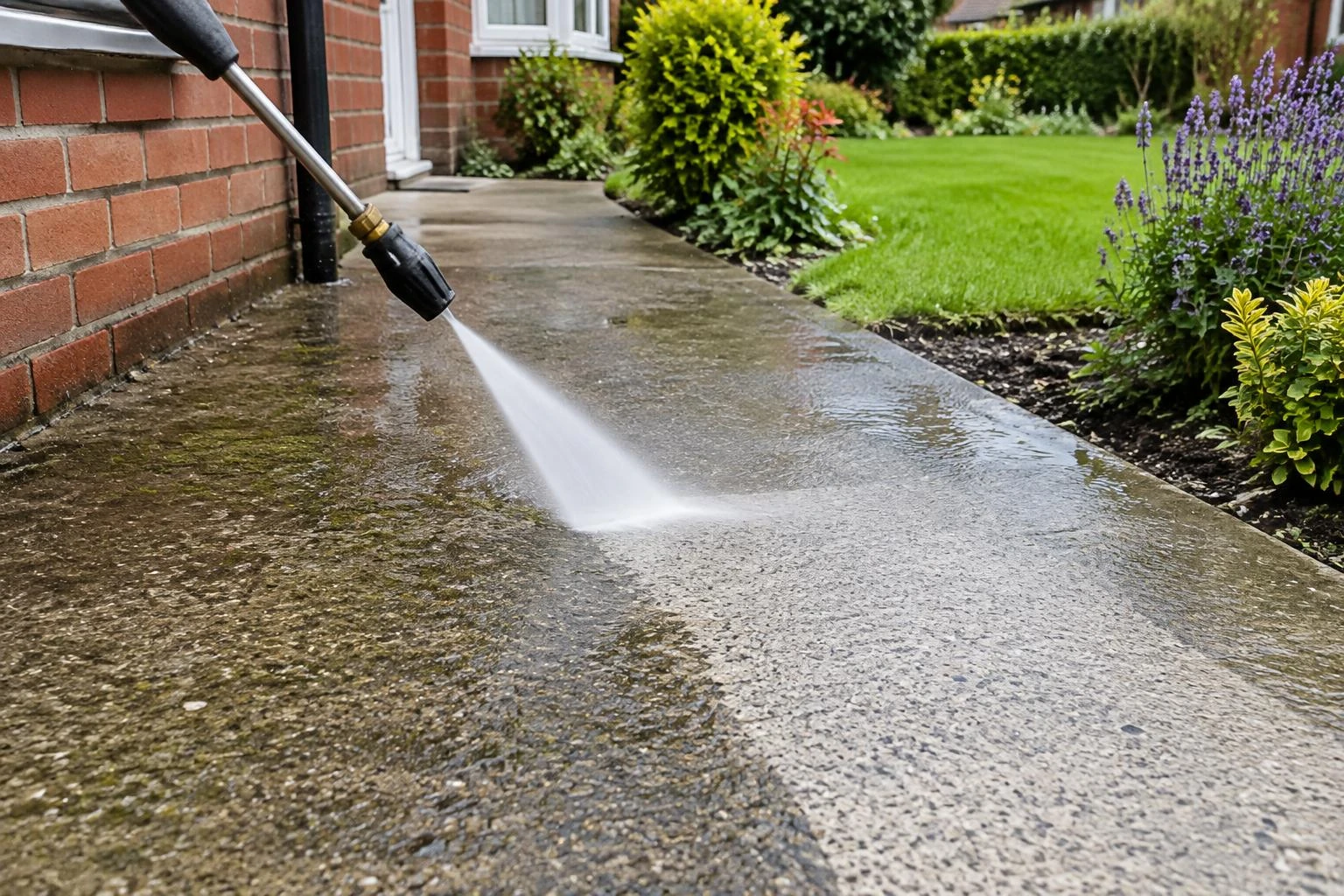
New-build paving and older tarmac
Pressure Washing in Ashford
Pressure washing in Ashford reflects how fast the town has grown. Large new estates have acres of block paving, while older streets still have tarmac and concrete drives. OOR External is based in Dover, and Ashford sits beyond the usual domestic radius of about fifteen miles, so please check your postcode before booking; commercial surfaces are quoted on request.
Request a free quoteFlood-prone ground beside the Stour
Ashford sits on the River Great Stour at the foot of the North Downs scarp, and the land around the river south of the station is flood-prone; recent building there stands on concrete stilts. The Ashford Green Corridor floodplain park follows the Great and East Stour, with a wide band of Flood Zone 2 alongside. Damp, shaded sites like these tend to show green algae on paving, paths and fences, and it returns faster than on open, higher ground.
On these surfaces, cleaning means treating the growth, washing at a pressure suited to the material and an after-treatment to slow regrowth. Runoff is managed so it does not head straight for a garden ditch or drain without thought.
Block paving on the newer estates
Park Farm was built in the late 1990s, Repton on the former Templer Barracks in the 2000s, and Finberry from 2013, so a large share of Ashford's drives are block paving laid in the last thirty years. New paving looks crisp for a while, then weeds appear in the joints, algae spreads where the drive is shaded and oil marks build up under cars.
Driveway cleaning on these estates usually means clearing joints, a surface clean at moderate pressure and re-sanding with kiln-dried sand once the blocks are dry. Keeping joints full is the best way to stop weeds coming back.
Shared courts and management companies
Many new estates have shared parking courts, paths and communal areas looked after by a management company. Cleaning these is arranged through the company rather than individual residents, and timing has to fit around residents' parking. Those requests are treated as commercial work.
Older drives from the overspill years
The 1959 London overspill scheme added around 5,000 homes and created most of South Ashford and Kennington, and many of those drives and paths are concrete or tarmac now several decades old. Tarmac is cleaned at lower pressure, because too much loosens the surface stones and binder. Weathered concrete may look patchy after cleaning, which is explained beforehand. Old tarmac that has started to break up will not be improved by heavy washing.
Patios, paths and fences
Across Ashford borough, about 32.7 per cent of homes are detached and 30.7 per cent semi-detached, so most have a rear patio and a side path. Rear patios range from concrete slabs in older gardens to sandstone and porcelain on the new builds, and each takes a different pressure and product. Side paths shaded by fences stay damp and green, and are a common slip risk.
Commercial parks and retail areas
The Designer Outlet, Orbital Park, Eureka Park and Waterbrook Park all sit within easy reach of the M20, with car parks, loading bays and paved entrances that collect tyre marks, gum, oil and algae along shaded kerbs. These are quoted as commercial work, cleaned in sections so parking and deliveries continue, with exclusion zones keeping pedestrians clear.
Older paving in the conservation areas
Ashford has eight conservation areas: Ashford Town Centre, Queens Road, Lacton Green, Willesborough Lees, Kennington and Ball Lane, Great Chart, Kingsnorth and Hothfield. Older brick paths, stone steps and setts around these streets are softer than modern concrete, and their mortar joints wear easily, so they are cleaned at low pressure with a suitable solution doing more of the work. Around the town centre, near the Grade I listed St Mary's churchyard and Middle Row, frontage paving is planned around footfall, with runoff kept away from doorways. Any loose bricks or lost jointing are pointed out rather than washed out further. With Chilmington Green planned at 5,750 homes, Ashford will keep adding new block paving, so the same new-build advice above applies to future streets too.
Linking with roof and gutter work
Roof moss and gutter overflow often stain drives and paths. The roof cleaning Ashford and gutter cleaning Ashford pages explain those services locally, and the ground is cleaned last when work is combined.
Requesting a quote
Start with your postcode so domestic coverage can be confirmed. Send photographs of the drive, patio and paths, and mention whether the drive is block paving, tarmac or concrete. A free quotation follows with each surface listed.
Related local pages
- Gutter Cleaning in Ashford
- Pressure Washing in Dover
- Pressure Washing in Kent
- Window Cleaning in Ashford, Kent
- Pressure Washing in Canterbury
- Pressure Washing in Folkestone
- Pressure Washing in Maidstone
- Pressure Washing in Thanet
- Pressure Washing in Sittingbourne
- Roof Cleaning and Moss Removal in Ashford
Pressure washing in Ashford: questions
- Why does paving near the Stour in Ashford go green so quickly?
- Land beside the Great and East Stour is low-lying and flood-prone, so paving there stays damp and shaded for longer, which suits algae. An after-treatment helps slow regrowth.
- Do you clean block paving drives on Finberry, Repton and Park Farm?
- Ashford is beyond the usual fifteen mile domestic radius from Dover, so please check your postcode first. Shared courts managed by estate companies can be quoted as commercial work.
- Can a tarmac drive be pressure washed?
- Yes, at lower pressure than concrete. Too much pressure loosens the surface stones and binder, so the drive condition is assessed first.