
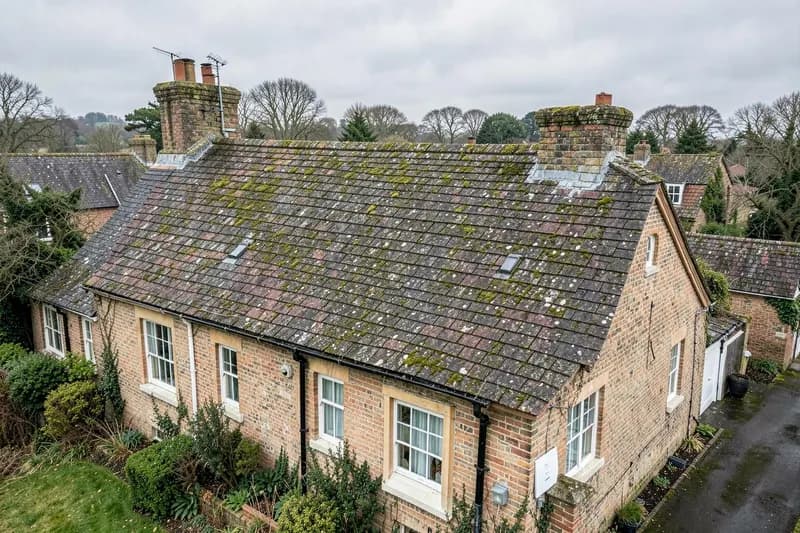
County-wide roof work from Dover
Roof Cleaning in Kent
Roof cleaning in Kent covers everything from coastal bungalows near Dover to commercial sheeting on industrial estates inland. OOR External assesses each roof for covering, pitch, condition and access before agreeing how the moss, lichen and debris will come off.
Request a free quoteHow far roof cleaning reaches across Kent
Domestic roof work is taken on within about fifteen miles of the base near Dover, which takes in Deal, Sandwich, Folkestone and the villages between. Commercial roofs are quoted further across the county, including Ashford, Maidstone, Canterbury and Medway. Separate pages cover the towns where roof enquiries are most frequent.
If you are unsure whether your address is covered, send the postcode first. Jordan will confirm before you spend time gathering photographs, and will say plainly if the roof sits outside the area.
Kent roofs and what grows on them
Kent has three building forms of its own: the oast house, the Wealden hall house and the Kentish peg-tile. Many oasts are now homes, and their roundels and cowls make for steep, conical roofs that are nothing like a standard pitched slope. Wealden hall houses carry large, steeply pitched roofs, and handmade clay peg-tiles, hung on pegs over battens, are thinner and more fragile than modern concrete tiles. On these roofs the method matters more than the moss: weight, pressure and scraping all risk cracked or slipped tiles, so any growth is removed by hand with a light touch, or left and treated where removal would do more harm.
Alongside that heritage, most Kent roofs are on ordinary houses. Across the Kent County Council area, which excludes Medway, about 25.4 per cent of homes are detached, 31.4 per cent semi-detached and 23.5 per cent terraced, and many of those carry concrete interlocking tiles whose rough face holds moss well. Business parks and farms carry coated metal and fibre cement sheeting.
Listed buildings and conservation areas are controlled by the district council, not Kent County Council, with Medway run separately as a unitary council. If an older roof may be protected, it is worth checking with the district before any work.
Roof moss removal in Kent
Thick moss is the most common reason a Kent roof gets booked in. It is lifted with care rather than jet washed, the gutters are cleared afterwards and a biocide can be added as a separate line to slow regrowth.
Commercial roofs in the county
On industrial units, warehouses and schools, coated metal sheeting usually suits a low-pressure soft wash. Fibre cement sheets and roof lights are fragile and assessed carefully. Work is planned around trading hours, deliveries and access, with exclusion zones below the roof.
Three Kent towns with their own roof pages
Ashford, Maidstone and Folkestone each have their own roof page, covering the local building eras, conservation areas and exposure in more detail than a county page can. Use them if your roof is in or near one of those towns; for anywhere else, send the postcode and photographs.
Tiles, slate and sheeting: the method follows the covering
Concrete tiles can take careful removal of loose growth, with a biocide applied afterwards. Clay and slate are worked more lightly because they crack. Coated metal sheeting is soft washed at low pressure: the treatment is applied, given dwell time and rinsed. Fibre cement and roof lights are never walked on. That is why a roof in Kent is looked at before any figure is given, whether it is a cottage or a distribution warehouse.
Lichen, algae and black staining
Not every dark roof is mossy. Lichen forms crusty grey or yellow patches that root into the tile and fade slowly after treatment. Algae leaves a flat black or green film. Both respond to treatment with time rather than force, and the lichen guide explains why patience is part of the result.
Planning around the people below
Whether it is a family home or a busy school, the ground under the roof matters. Cars are moved, paths are kept clear while debris comes down, and on commercial sites exclusion zones are set and timing is agreed around deliveries and opening hours.
Choosing roof cleaners in Kent
Ask any roof cleaner how they will treat your covering, whether the gutters are included and whether aftercare is a separate line. A clear written quote that answers those questions is worth more than a quick figure over the phone. Send your postcode and a few photographs taken safely from the ground for a free quotation.
Related local pages
- Roof Cleaning in Dover
- Roof Cleaning in Canterbury
- Commercial Roof Cleaning in Medway
- Pressure Washing in Kent
- Roof Cleaning in Thanet
- Roof Cleaning in Sittingbourne
- Solar Panel Cleaning in Kent
- Gutter Cleaning in Kent
- Roof Cleaning and Moss Removal in Ashford
- Roof Moss and Lichen Removal in Maidstone
- Roof Cleaning in Folkestone
Sittingbourne roof enquiries
Roof cleaning in Kent: questions
- Do you clean roofs everywhere in Kent?
- Domestic roofs are cleaned within about fifteen miles of the Dover base. Commercial roofs are quoted further across Kent. Send your postcode to check.
- Is roof moss removal in Kent done with a pressure washer?
- No. Moss is lifted with care because high pressure can force water under tiles. A biocide can follow to slow regrowth.
- Can you clean an old Kentish peg-tile roof?
- It is assessed first and treated very gently. Handmade clay peg-tiles are thin and fragile, so nothing is pressure washed or walked on, and if leaving the roof alone is safer you will be told.
- Do you clean oast house roofs?
- Oasts are assessed case by case because the conical roundels and cowls need their own access plan. Many are now homes; send photographs from the ground and the postcode.
- Do Kent coastal roofs need cleaning more often?
- Shaded slopes near the sea stay damp longer, which suits moss and algae, so they can regrow sooner than sunny inland slopes.
- Can you clean my roof and gutters in one visit?
- Yes. Gutters and outlets are cleared after the roof work as standard, because that is where the moss ends up.