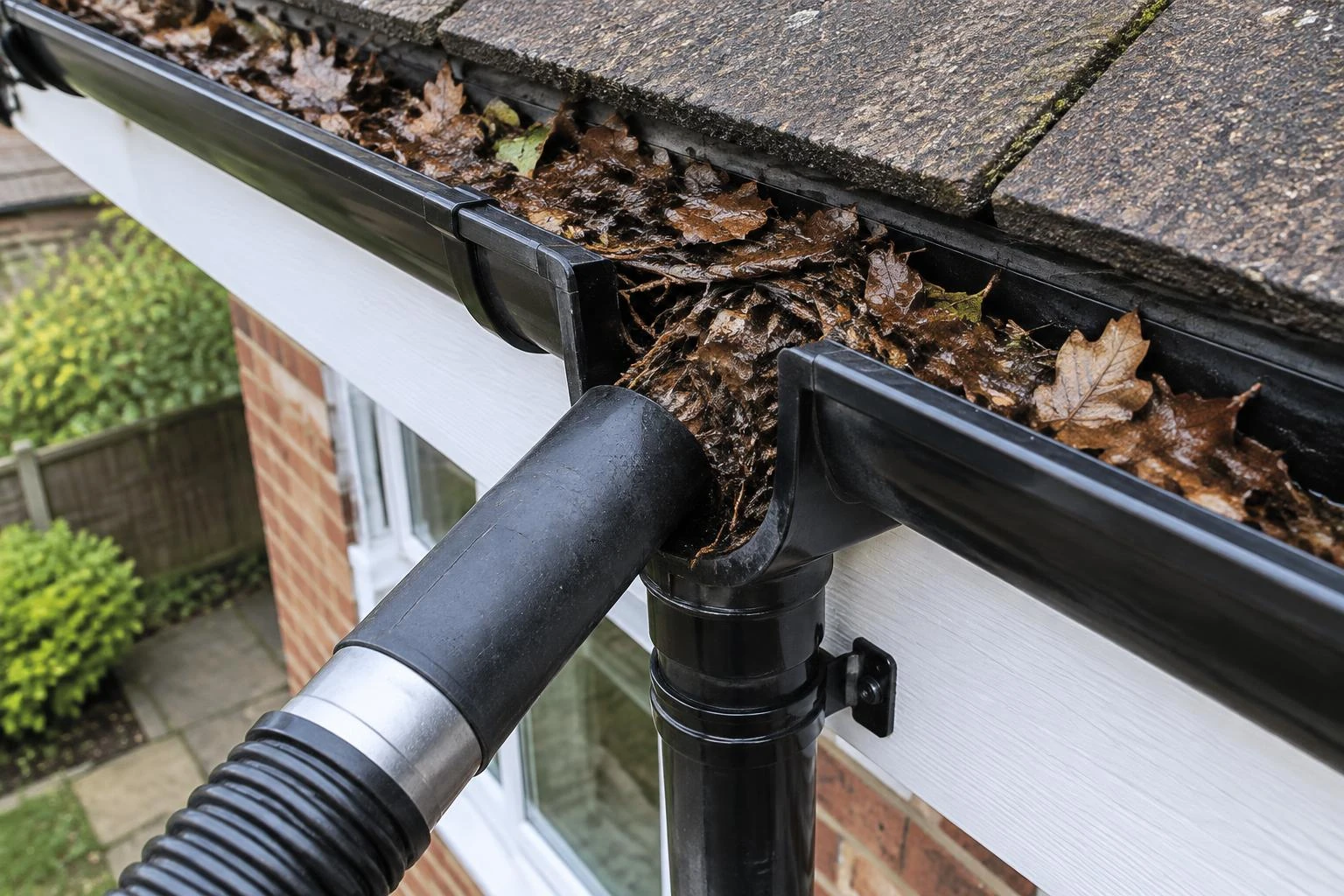
Most blockages sit at the outlet, where the gutter meets the downpipe. Leaves, moss from the roof and silt wash along the channel and collect at the narrowest point. Swan neck bends under deep eaves are another common trouble spot, as debris lodges in the curve. Further down, a downpipe can block at an offset, a joint or the shoe at the bottom.
Corners of a gutter run and sections beneath trees or a mossy roof fill fastest. A run with a slight dip may hold standing water that slowly turns to sludge. Knowing where water spills tells us where to start looking.
Blocked gutter cleaning begins with removing the debris from the channel itself. High-reach vacuum equipment extracts leaves, moss and silt from the ground where the gutter position and approach allow, which avoids ladders resting against the gutter. Once the channel is clear, the outlet is opened so water can reach the downpipe again.
If the roof is shedding moss heavily, the gutter will fill again. In that case roof cleaning and gutter clearance are worth discussing together, with the gutters cleared after the roof work.
A blocked downpipe is approached from the top first, at the outlet and any swan neck, because that is where debris most often stops. Material lodged lower down may be reached from the shoe or an access point if one is fitted. Some blockages are deep inside a pipe, inside a boxed-in section or below ground in the drain, and those are identified rather than forced.
Cleaning is not a repair. A cracked pipe, a loose bracket or a joint that has separated should be pointed out so you can decide on any repair work. A drain blocked underground is a separate matter for a drainage specialist.
After clearance, water flow is checked where it is practical to do so. The aim is for the run, the outlet and the top of the downpipe to carry water as they should. If the outside of the gutter or the fascia is stained, washing can be quoted as a separate line, because appearance and drainage are different tasks.
The overflowing gutters guide explains why water spills in heavy rain even on clear gutters, and the gutter vacuuming guide covers the equipment in more detail.
Tell us where water overflows, whether a downpipe drips or gushes at a joint, and whether the drain at the bottom fills. Photographs from the ground of the gutter run, the downpipe and the space beneath help with planning access. Mention conservatories, extensions or narrow passages beside the wall.