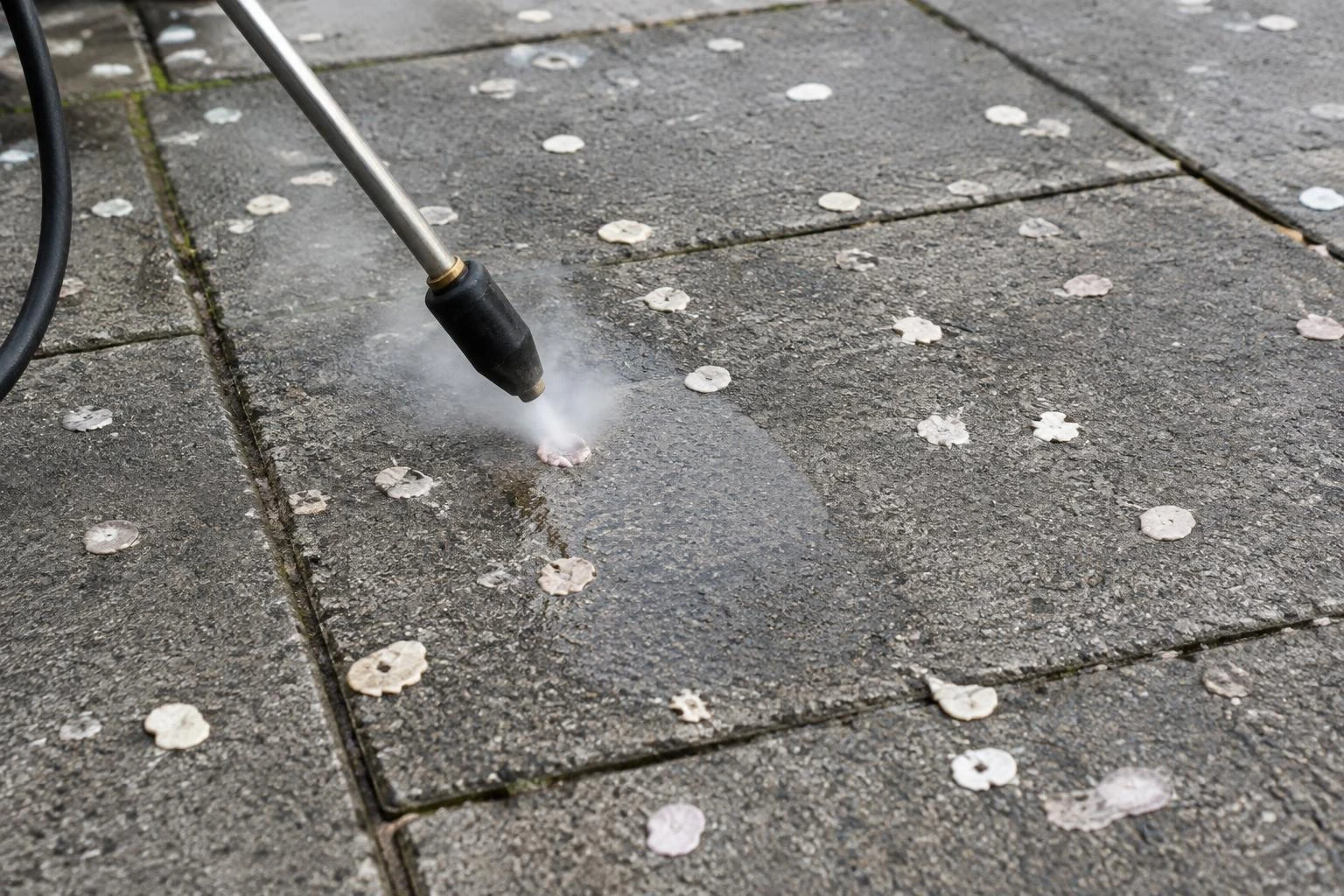
Modern gum is designed not to dissolve. Pressed into paving by foot traffic, it fills the texture of the surface and hardens as it cools. Dust and grime then stick to its top, which is why old gum looks black even though it began as a pale colour.
Cold pressure washing tends to smear rather than lift it, and at the pressures needed to break it out, the paving itself can be marked. A suitable method must be agreed after assessing both the deposit and the paving.
Shop entrances and doorways collect gum faster than anywhere else, along with the pavement directly outside. School paths and gates, transport waiting areas and the approach to office buildings are other common hotspots. Retail parks often have concentrated deposits around benches and car park walkways.
On private land the owner or occupier is usually responsible. Public pavements are generally the local authority's, so for frontages that spill onto the highway the scope is agreed carefully with the client before work starts.
Different paving responds differently. Concrete flags, block paving, natural stone and resin surfaces all need the treatment and dwell adjusted so the gum releases without damaging the finish. Joints in block paving are watched to avoid washing out sand. A small test area is often done first on unfamiliar surfaces.
Some faint marking can remain where gum has stained a porous surface for years. That residue is discussed honestly. A general wash of the area afterwards helps blend the cleaned spots with the surrounding paving, and that can be included as part of the scope.
Gum removal is often part of a wider tidy of a commercial frontage. Pavement and forecourt cleaning, graffiti removal from walls and shutters, and canopy cleaning above the door can all be programmed together. The car park and forecourt cleaning page covers the larger hard surfaces around retail and office sites.
Doing several items in one visit reduces disruption to trading and keeps the frontage consistent. Each element is still priced separately so you can choose what matters most to your premises.
Work is planned for quiet times so customers and pupils are kept clear of the equipment, with exclusion zones and cones around the active area. Early mornings, evenings or school holidays are common choices. Equipment needs space for the van nearby, and that is confirmed in advance.
Send photographs showing the density of gum and the extent of the area, along with the postcode and opening hours. Commercial work is quoted across Kent from Dover, and the quotation is free with no obligation.