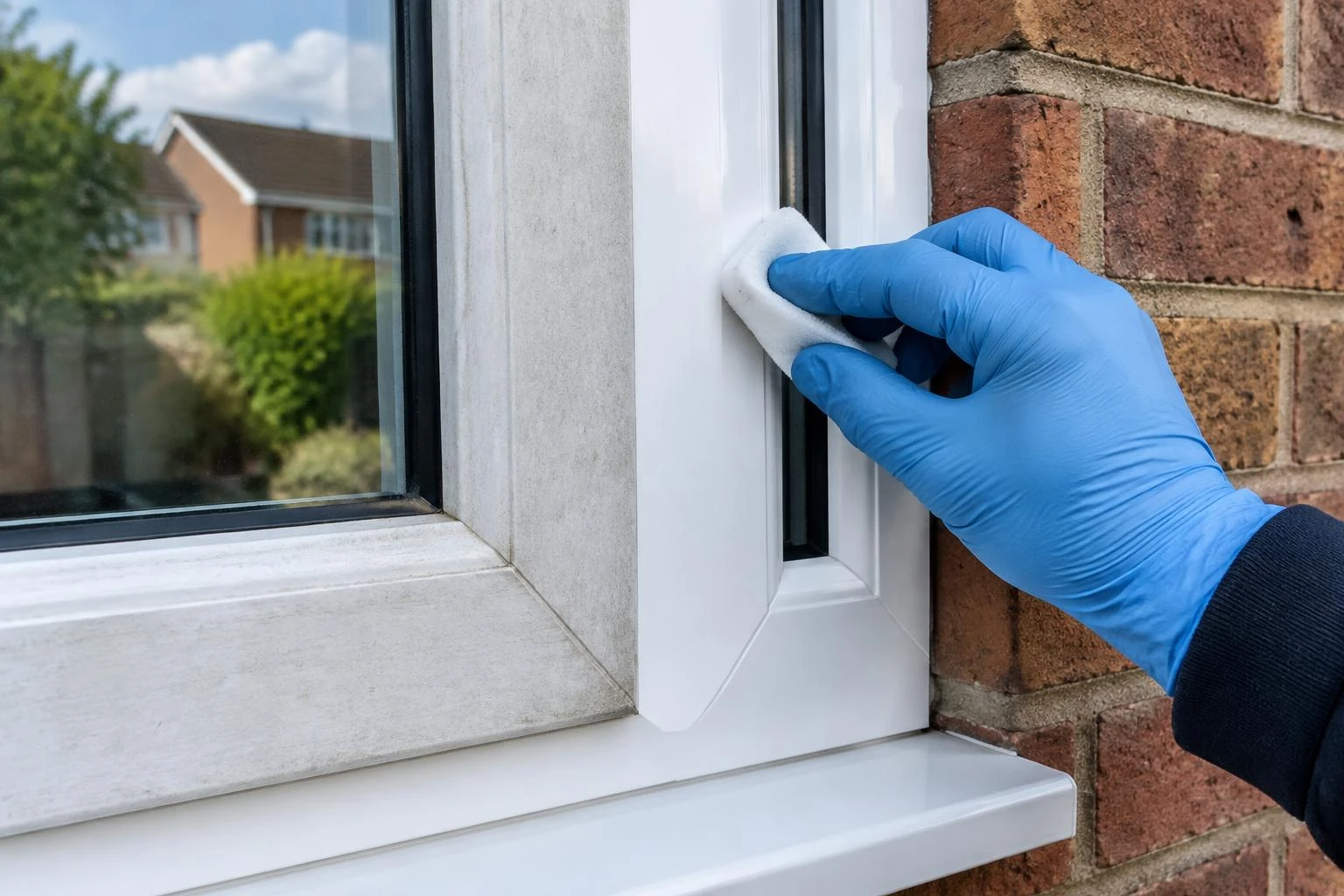
Ultraviolet light slowly attacks the outer skin of uPVC. Over years the surface becomes porous and powdery, which is the chalky residue that comes off on your fingers. That rough skin then grabs dirt, soot and pollution, so the plastic looks grey even straight after rain. Some older or cheaper profiles also yellow as their stabilisers wear out.
South and west facing elevations usually suffer most, because they take the strongest sun. Homes near the coast or a busy road add salt film and exhaust grime on top of the oxidation.
The work starts with a normal wash to remove loose dirt and organic growth. Suitable uPVC cleaning products are then worked into the surface by hand, giving them time to break down the oxidised layer and the staining bonded to it. Each section is rinsed thoroughly before moving on, so residue is not left to dry on frames or glass.
Window seals, door furniture and glazing are worked around carefully. Nearby render, brick or paving is protected from runoff, and plants below are rinsed if needed.
Lightly weathered plastics often come back close to their original colour. Moderately faded boards usually brighten noticeably, though they may not look brand new. Where the surface has deep yellowing that runs through the plastic, cleaning can remove the dirt and chalk but cannot reverse the colour change itself.
This is why a test area is useful. It shows what that particular plastic will do before the whole house is booked.
Badly degraded uPVC may need replacing rather than restoring. Boards that are cracked, brittle, warped or crumbling at the edges will not be improved by cleaning, and aggressive scrubbing could make them worse. If fascias or soffits look like that, you will be told so, and a roofline installer is the right person to speak to.
Cleaning is also not a fix for leaking frames, failed seals or loose boards. Those issues are pointed out rather than hidden under a cleaner finish.
Fascias, soffits, bargeboards, guttering, window and door frames, plastic shiplap cladding and conservatory frames are all suitable candidates. Coloured or foiled uPVC, such as grey or woodgrain finishes, needs a gentler approach because the surface film can be marked, so it is assessed separately.
Composite door skins and powder coated aluminium are different materials and are not treated the same way.
Restoration is often combined with gutter clearing, a render or brick clean, or soft washing the walls, so the whole frontage is finished together. The guide to uPVC fascia and cladding cleaning explains routine care if the plastics are still in decent condition.
Domestic work is carried out within about fifteen miles of the Dover base. Homes further away can check their postcode, and every quote is free.