
Need this sorted?
Need help with roof cleaning? Book roof cleaning or get a quote from OOR External.
Damage comes from the wrong action, not just water
A roof is assembled from overlapping pieces, junctions and fixings. A method that appears gentle on one tile can still push water into a lap or disturb a weak ridge joint. The relevant question is how the whole roof will be approached, not simply which machine will be used.
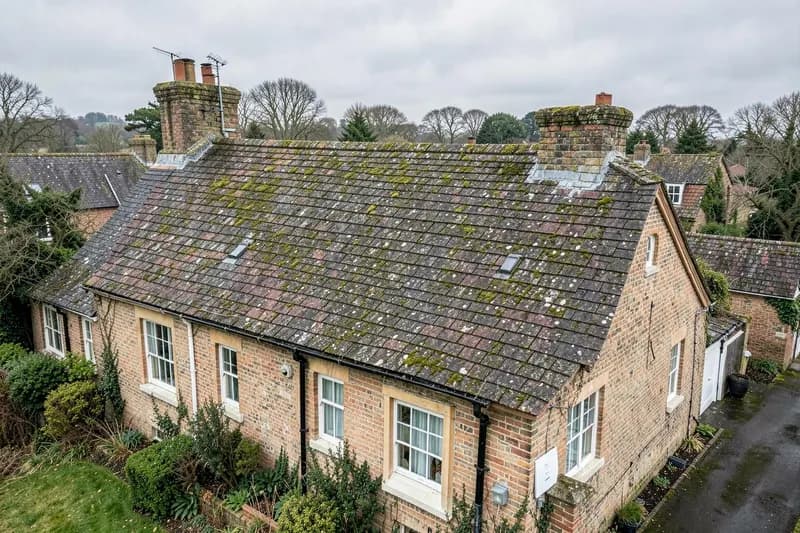
Condition changes the answer. A cracked tile, weathered edge or loose slate may tolerate less disturbance than the neighbouring surface. Assessment of the covering, pitch, condition and access should happen before a cleaning method is named in the quotation.
Scraping attached growth from a weak face
Removing loose moss and scraping firmly attached lichen are not the same task. A hard tool dragged repeatedly over a fragile or worn face can take roof material with it. Trying to achieve a completely spotless finish in one visit may therefore be the wrong priority.
Moss at joints should be approached with care rather than levering against the tile edge. For remaining organic growth, treatment may allow a more gradual change. Ask how the contractor will decide what to lift and what to leave for an appropriate treatment to address.
High pressure and vulnerable overlaps
Water directed forcefully across a roof can enter places designed to shed rainfall coming from above. Edges, laps and small defects are vulnerable, and mortar can be washed from weak joints. Pressure alone also says little about how close a nozzle is held or which direction it points.
The separate pressure-washing-a-roof guide discusses that method in more detail. Here the key point is to avoid a blanket promise that one approach suits every covering. OOR External assesses the roof first; natural slate is cleaned by soft wash only.
Foot traffic can be the hidden source of harm
Tiles can crack under weight even if the cleaning product is suitable. Walking on a roof also creates a fall risk, and rooflights or sheets may be fragile. An apparently convenient route to the ridge should not be assumed safe because somebody has used it before.
Ask how the roof will be reached and whether specialist access is required. Those arrangements should be discussed and priced before work starts. Never climb onto an extension or roof to take better enquiry photographs; safe ground-level views are the appropriate starting point.
Details beyond the centre of the tile
Ridge and hip mortar, flashing junctions and valleys deserve attention alongside the covering. Loose mortar or a slipped piece needs roofing advice, not extra washing. If you know of previous repairs or a current leak, tell Jordan before an assessment is arranged.
An adjoining conservatory or lower extension can also receive debris and runoff. A careful scope considers the roof below as well as the one being cleaned, and protects nearby surfaces. Clearing gutters and outlets afterwards avoids leaving loosened material where rainfall needs to pass.
Treatment has limits as well
Biocide is a separate optional line, selected in light of the surface and the growth. It does not strengthen a cracked tile, repair a failed junction or justify using an incompatible product on a membrane. Instructions and material compatibility still matter when pressure is low.
Organic growth may die back and weather away gradually. That is not the same as a repair or a promise of immediate uniform colour. Discuss the expected appearance, particularly where lichen remains attached after the cleaning stage.
Questions that make a quotation more useful
Ask which covering has been identified, how loose growth will be handled, how access will avoid unnecessary loading and what happens if a defect is found. A clear answer to each gives you more information than a claim that cleaning is always harmless.
Send photographs showing a complete slope and the surrounding ground. Point out any known crack, slipped slate or leak without trying to inspect it yourself. If the roof needs repair, a roofer should assess it first. Cleaning can then be considered only when the condition supports the proposed method.
Need it sorted? Book roof cleaning
Discuss your roof cleaning enquiry with Jordan Sartain at OOR External. Use the existing quote form below and include photographs taken safely from the ground and your postcode.